What's new at Luminary: November update

This month, Luminary AI can build a complete estate waterfall from a common plan structure and a few details about the client, with no documents or data entry needed. Projections now account for income tax drag across trusts and entities, so advisors can compare strategies on an after-tax basis. New AI-generated business entity slides, state estate and inheritance tax education slides, and a built-in review and approval step for client presentations round out the release, along with faster, more capable AI behind the scenes.
From First Conversation to Estate Waterfall in Minutes
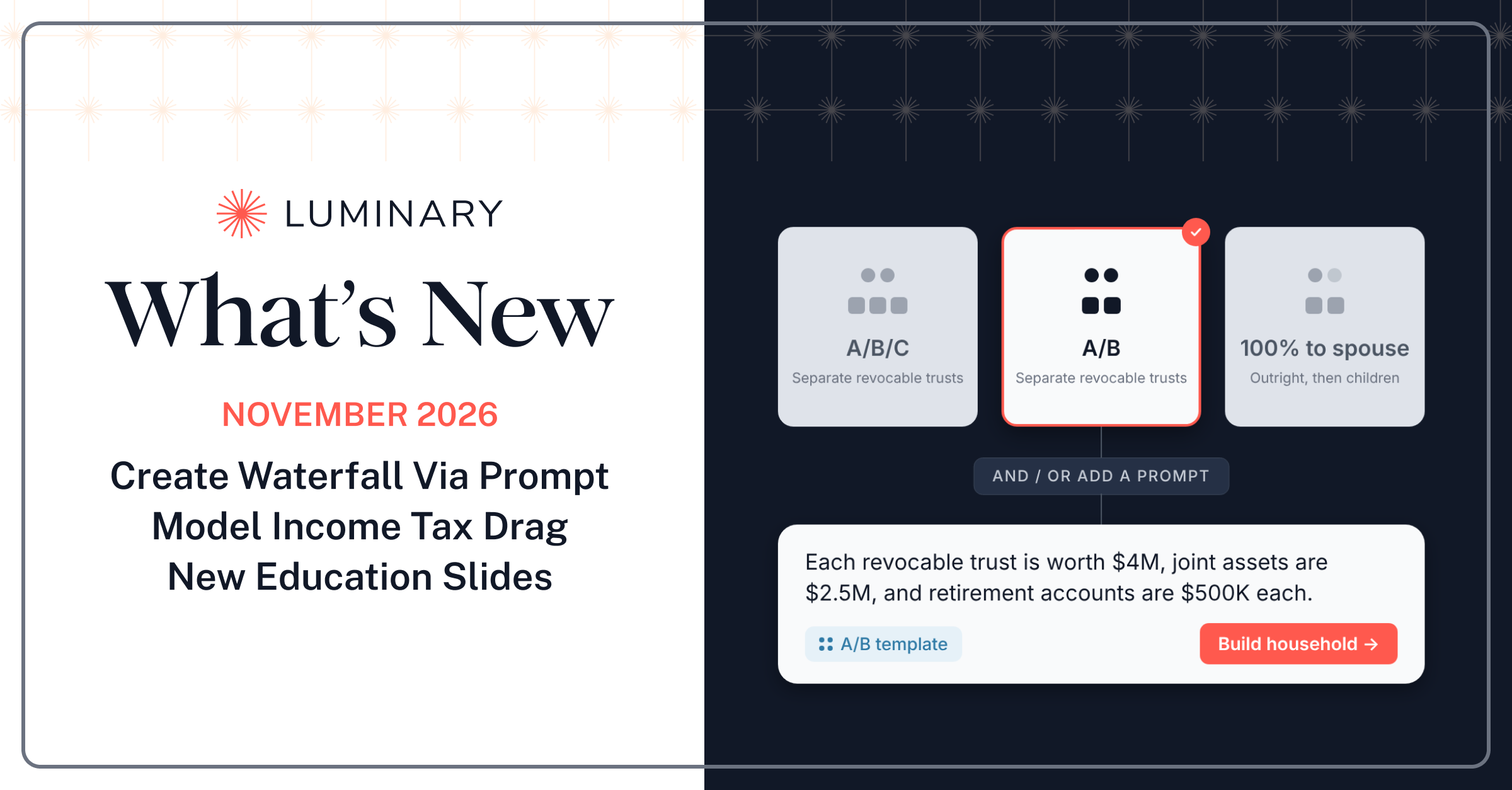
Luminary AI can now build a complete estate waterfall from a few simple inputs, with no documents or manual data entry needed.
Luminary already turns estate documents into a modeled plan. Now advisors can get to the same place before any documents are in hand. That could be an early prospect meeting, a client who hasn’t shared their trust agreements yet, or a family still deciding on a plan. The advisor picks a starting point and describes the client’s situation, and Luminary AI builds the rest.
Here’s how it works:
- Start from a common plan structure: Choose from a set of common disposition patterns to serve as the base of the plan.
- Add context in plain language: Tell Luminary AI what’s specific to the client’s situation, such as family members, key assets, or planning goals.
- Let the agent build the plan: Luminary AI creates the entities, enters asset values, sets up dispositions, and fills in entity details to produce a fully built estate waterfall.
Within minutes of onboarding a new household, advisors have a working estate waterfall they can review, refine, and present. Advisors can show prospects what their plan looks like at the first meeting, explore scenarios before documents are drafted and bring estate planning into more client conversations.

Model income tax drag across trusts and entities
Luminary’s estate waterfall now accounts for the income taxes generated by trust and entity returns, so projections show after-tax growth. Advisors can set rates by asset category or by entity, have Luminary calculate a blended effective rate, and choose which entities pay the tax on grantor trust income. The gift, sale, and loan modelers reflect tax drag too, so advisors can compare strategies, such as making a gift to a grantor trust vs a non-grantor trust, on an after-tax basis.
New education slides: states with an estate or inheritance tax
Luminary’s education slides now include a dedicated section on states with an estate or inheritance tax, with details for each state. Advisors can walk clients through the rules where they live, and the updated layout keeps a long list of states easy to browse.
New AI-powered slide: business entities
Luminary can now generate a slide summarizing a client’s business entities, covering each entity’s jurisdiction, purpose, ownership, governance, and termination provisions. It comes built into the Estate360 and Comprehensive Estate Analysis presentation templates, and advisors can add it to any presentation on its own.
Faster, more capable AI behind the scenes
Luminary keeps upgrading the AI models it relies on for speed and accuracy, so advisors can stay focused on planning instead of the technology. AI data extraction now pulls trust structures, dispositive provisions, and entity details from documents 40–70% faster, and full household refreshes finish about 40% faster. Document summaries now use a more capable model family that produces richer, more detailed summaries of complex scenarios.
Built-in review and approval for client presentations
Firms can now require a review step before a presentation goes to a client. A “draft” watermark stays on until the presentation has been reviewed. Firms can either let advisors confirm their own review or send presentations to designated approvers for central sign-off, and each presentation records who reviewed it and when. New role permissions also let firms control who can work with the estate waterfall and dispositive provisions.
The Estate Planning AI Face-Off Part 3: The Team-Up
The face-off set the stage, and now it’s time for the team-up. On Wednesday, November 11 at 12 PM ET, Luminary’s Patrick Gordon and Ian Lyons will show what happens when general-purpose AI tools connect to Luminary’s structured estate data through MCP. Can’t make it live? Register anyway and we’ll send you the recording.
Luminary AI, Everywhere You Work
Luminary’s verified estate data is now available in the AI tools your team already uses, including ChatGPT, Claude, and Copilot. Inside Luminary, the AI Assistant can now build plan structures from plain-language descriptions, and SmartReview onboarding turns estate documents into a modeled plan in about five minutes.
Three Questions Every Firm Should Ask While Investing in AI Technology
Using AI on your own is getting easier, but getting it to work reliably across a whole firm is still hard. In part two of his series, Pat Gordon revisits three questions for firms investing in AI: how to build systems that scale, what should serve as your AI control center, and when to build versus buy.