Luminary AI, Everywhere You Work


Our latest AI enhancements help your team quickly and easily move from estate data to action, inside Luminary and across other AI tools you already use.
Wealth transfer insight and advice are among the most meaningful of all private wealth client deliverables. The work is complex, nuanced, and requires unique precision and compliance to be delivered consistently at scale. Luminary was purpose-built for the most complex and sensitive trust and estate work; combining verified, source-linked data, deterministic calculation methodology, and use case-specific visualizations to deliver precise outputs advisors can trust. Until now, those capabilities lived exclusively within Luminary.
We’ve made several enhancements to Luminary AI that extend how your firm can get the most out of specialized estate intelligence, no matter where you work. Luminary’s MCP connection makes our verified client data set available in any AI tool you’re using. Expanded Luminary Assistant capabilities empower users to retrieve data, synthesize information, and create analyses simply by speaking into a microphone. Plus, our new guided onboarding workflow entirely automates the process of creating a client profile.
These updates dramatically decrease the time from collecting client documents to producing valuable analyses and insights, whether you’re working in our app or through an external tool of your choice.
Luminary Now Works Inside Any AI Tool
A general-purpose AI assistant can help summarize a document, prepare for a meeting, and draft a presentation. But for wealth transfer work, which is as nuanced as it is complex, using general-purpose tools can be risky. Doing this work accurately is dependent on verified plan structure and details, an up-to-date balance sheet, and calculation methodology that reflects the latest federal and state law. Without these foundational elements, answers, analyses and client deliverables can be inconsistent or incorrect, even when they sound convincing.
With the launch of the Luminary MCP server, we’re now bringing the level of consistency, compliance and control that users have come to expect within the Luminary platform into the AI tools that your team is already using. Users can now access Luminary’s estate intelligence directly from ChatGPT, Claude, Copilot, and any other AI systems your team depends on.
The Luminary MCP comes with pre-packaged skills and can help you accomplish a variety of tasks directly, including:
- Answer questions about a client’s estate plan. Ask “Who is the trustee of the John Doe trust?” or “What access do the children have to the Dynasty Trust?”
- Calculate projected outcomes. Ask “What is the estimated estate tax if John Doe dies in 2050?” or “What is the estimated dollar value of what John’s eldest child will receive?”
- Recreate Luminary presentation material in other presentation tools. Turn Luminary data into client-ready PowerPoint presentations that exactly match your firm’s branding.
- Create an estate waterfall diagram in your preferred style. Show how wealth passes to beneficiaries using Luminary’s entity values, dispositive provisions, and tax calculation and distribution logic.
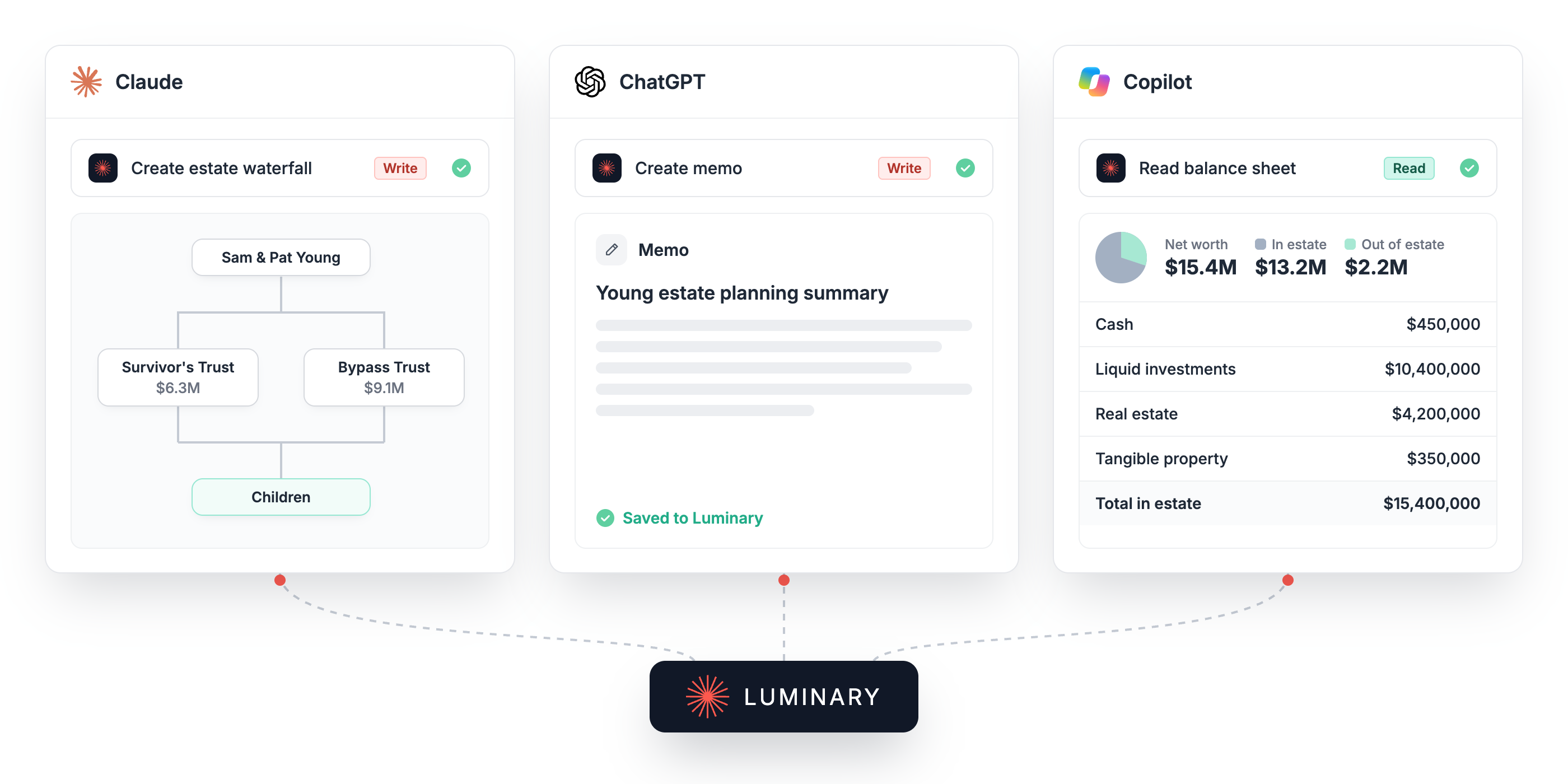
These examples illustrate how specialized software and general-purpose AI work better together. ChatGPT or Claude helps coordinate the task and shape the explanation or deliverable. Luminary supplies the specialized and verified estate-planning context and calculations. Your team reviews the work and applies its judgment.
Set up a demo to see for yourself
Luminary’s AI Assistant Completes Tasks On Your Behalf
Within the Luminary application, we’ve expanded the AI Assistant’s ability to complete tasks on your behalf.
In addition to using the assistant to retrieve and synthesize data, you can now create data, including complex plan structures. Describe what you want in plain language, and the assistant creates data that automatically feeds into Luminary’s estate projections, diagrams, and presentations.
Examples of data supported include:
- Family and trust structure: Individuals, organizations, entities, and sub-trusts
- Assets and liabilities: Assets, liabilities, and life insurance policies
- Plan structure: Dispositive provisions and beneficiary designations, including common patterns such as pour-over wills and A/B trust structures
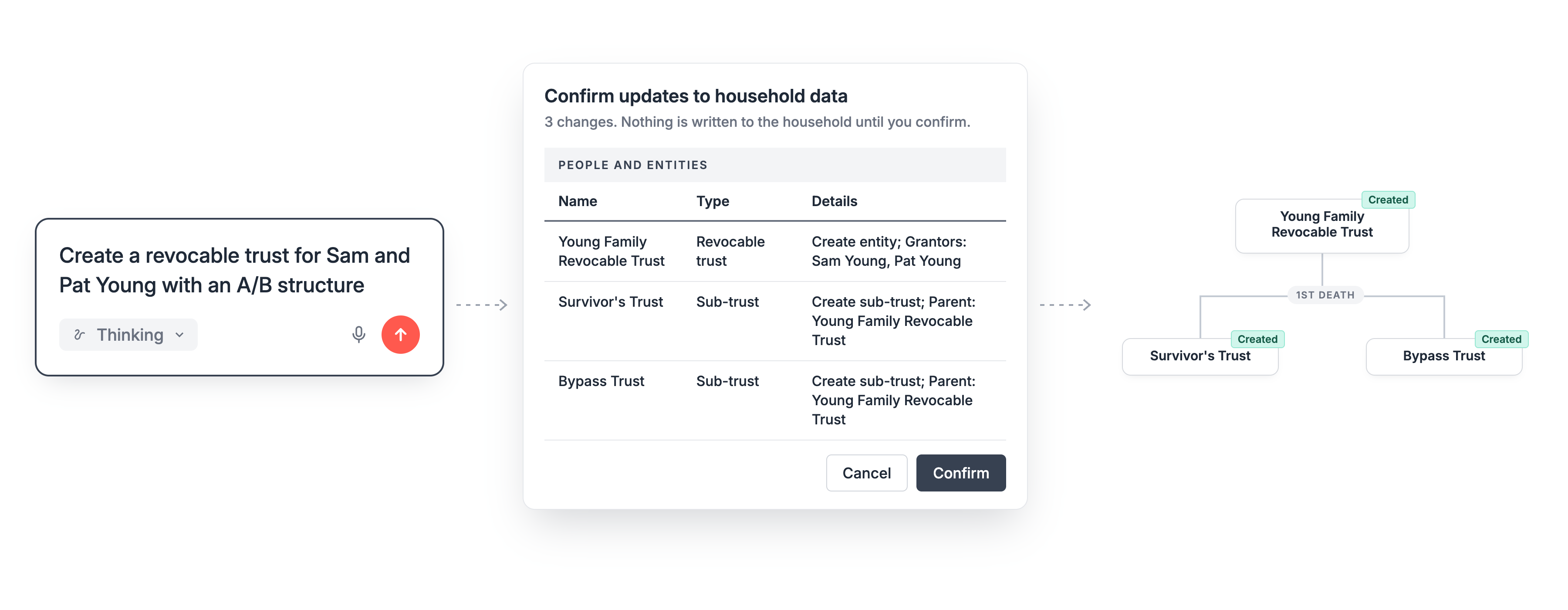
You can also create multi-document analyses directly through the assistant. For example, say “produce a fiduciary report that outlines all trustees and successor trustees” and the Luminary assistant will create a client-facing deliverable in seconds.
As you learn about a family or receive updated financial information, you can build and refine the profile through conversation—which means less time navigating the platform and more work completed through a single chat.
Client Onboarding Is Faster and Simpler Than Ever
The goal is simple: turn estate documents into a modeled plan in five minutes. Our enhanced SmartReview onboarding process now automatically approves information extracted from estate documents when it exceeds a 95% confidence threshold, and clearly calls out when your manual review is required for more complex data.
Once profile creation is complete, Luminary automatically generates a presentation based on a template that you’ve selected. This process reduces repetitive workflow and data review and helps users reach a high-confidence, tailor-made client deliverable in minutes.

All of these enhancements bring Luminary’s estate intelligence closer to wherever your team is working—from building a client profile to preparing a presentation in your preferred AI tool. With less time spent entering, reviewing, and moving information, your team has more capacity to help families understand their plans and make informed decisions.
Request a demo to see how Luminary can support your firm’s AI-powered workflows.